

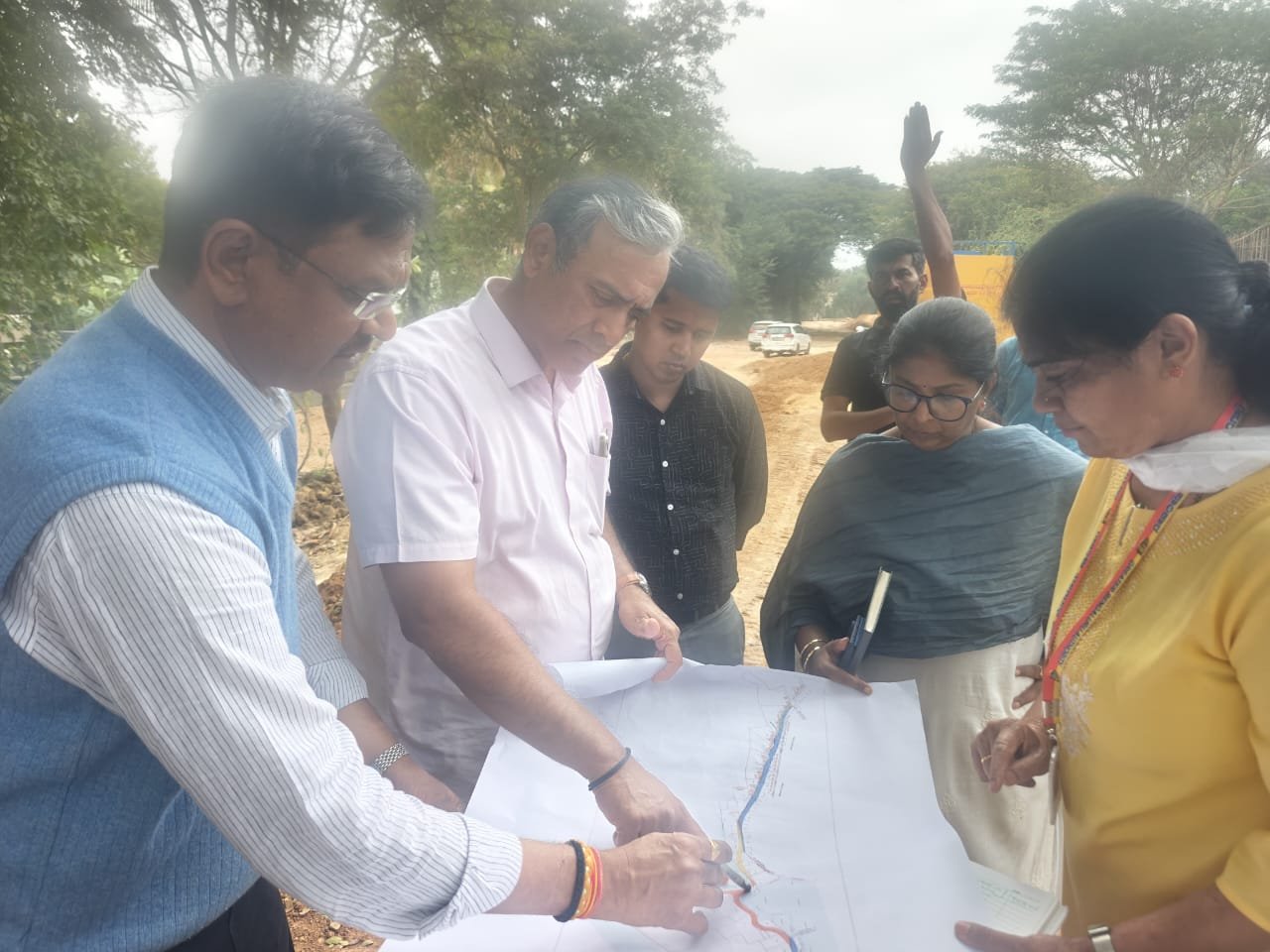
Bengaluru: A directive issued by Greater Bengaluru Authority (GBA) Chief Commissioner Maheshwar Rao, IAS, ordering a survey for road construction within the Bellandur Lake buffer zone, has triggered serious legal and environmental concerns, as multiple statutory laws, planning regulations, and judicial precedents place strict prohibitions on construction inside lake and tank buffer areas.
While the official justification cited by the GBA is traffic decongestion, environmental experts and legal observers point out that no publicly available order from the National Green Tribunal (NGT), Supreme Court, or the State Government currently permits fresh road construction inside a notified lake buffer zone.
The issue assumes greater significance given Bellandur Lake’s status as one of Bengaluru’s most environmentally sensitive and legally scrutinised water bodies, repeatedly flagged by courts for protection and restoration.
WHAT THE LAW CLEARLY STATES
Karnataka Tank Conservation & Development Authority Act
Under Chapter III – Protection of Tanks, the law categorically prohibits:
• Construction of roads, bridges, or structures within tank areas or tank bunds without Government permission
• Any activity within 30 metres of the outer boundary of a tank
• Obstruction of natural inflow or outflow of water
• Any act detrimental directly or indirectly to tanks
Section 12(6) explicitly states:
“No roads, bridges or similar structures shall be constructed within the tank area including the tank bund without permission of the Government.”
Violations empower authorities to seize machinery, halt works, and initiate criminal proceedings.
BUFFER ZONE RULES UNDER RMP 2015 & PLANNING LAW
As per the Revised Master Plan (RMP) 2015, Bellandur Lake is categorised under Valley/Drain and Park & Open Space (P) zoning, which mandates:
• A mandatory 30-metre ‘No Development Zone’ around lakes
• Only non-obstructive uses like pathways or drains are conditionally allowed
• No fresh development permissions in valley zones
• Roads allowed only if they do not obstruct natural water flow and only with explicit statutory approvals
Any deviation requires clearances under planning law, environmental law, and judicial compliance, not merely an administrative inspection or survey.
NGT & SUPREME COURT: SETTLED LEGAL POSITION
In the landmark Forward Foundation cases (2016), the National Green Tribunal ruled that:
• Lake buffer zones are ecologically sensitive no-construction zones
• Infrastructure convenience cannot override environmental protection
• Government agencies act as trustees of lakes, not developers
Subsequently, in Mantri Techzone Pvt Ltd vs Forward Foundation (2019), the Supreme Court held that buffer zones must be restored as per the zonal plan/master plan, recognising:
• 30-metre buffer around lakes
• 50m / 25m / 15m buffers from primary, secondary, and tertiary rajakaluves
The legal position today is clear: lake buffers are not discretionary spaces.
CORE CONCERNS RAISED
Despite this settled legal framework, the GBA press communication does not mention:
• Any NGT or Supreme Court order permitting road construction
• Environmental clearance or Wetlands Act compliance
• Government approval overriding tank protection laws
• Legal vetting prior to ordering the survey
Sources indicate that engineering officials attempted to flag buffer-zone constraints during the inspection, yet the survey directive was still issued—raising questions about procedural overreach.
“SURVEY FIRST, LAW LATER?”
Environmental experts warn that ordering surveys without resolving legal prohibitions sets a dangerous precedent, especially in lake ecosystems.
“In buffer zones, even a survey becomes the first step towards legitimising illegality,” a senior environmental lawyer noted.
Bellandur Lake is already under stress from flooding, sewage inflow, encroachments, and prior violations. Any dilution of buffer protections could have irreversible ecological consequences.
GOVERNANCE UNDER SCRUTINY
As the top civic administrator overseeing five city corporations, the GBA Chief Commissioner is expected to ensure that law precedes infrastructure ambition—particularly in ecologically sensitive zones.
Failure to do so exposes the government to:
• Legal challenges
• Tribunal intervention
• Public opposition
• Accountability for environmental damage
WHAT LIES AHEAD
Unless backed by:
• Explicit NGT or Supreme Court relaxation
• Statutory planning approvals
• Environmental and wetland clearances
Any attempt to construct roads inside Bellandur Lake’s buffer zone is likely to be legally stalled.
BOTTOM LINE
Traffic congestion is a governance challenge—but lake protection laws are not optional.
Any road inside Bellandur Lake’s buffer zone must pass legal, environmental, and judicial tests, not just administrative inspections.
For Bengaluru, the real test is not how fast projects are announced—but how lawfully they are executed.
Also Read: 300 km of Buffer Roads Planned Across Bengaluru: DK Shivakumar
About the Author