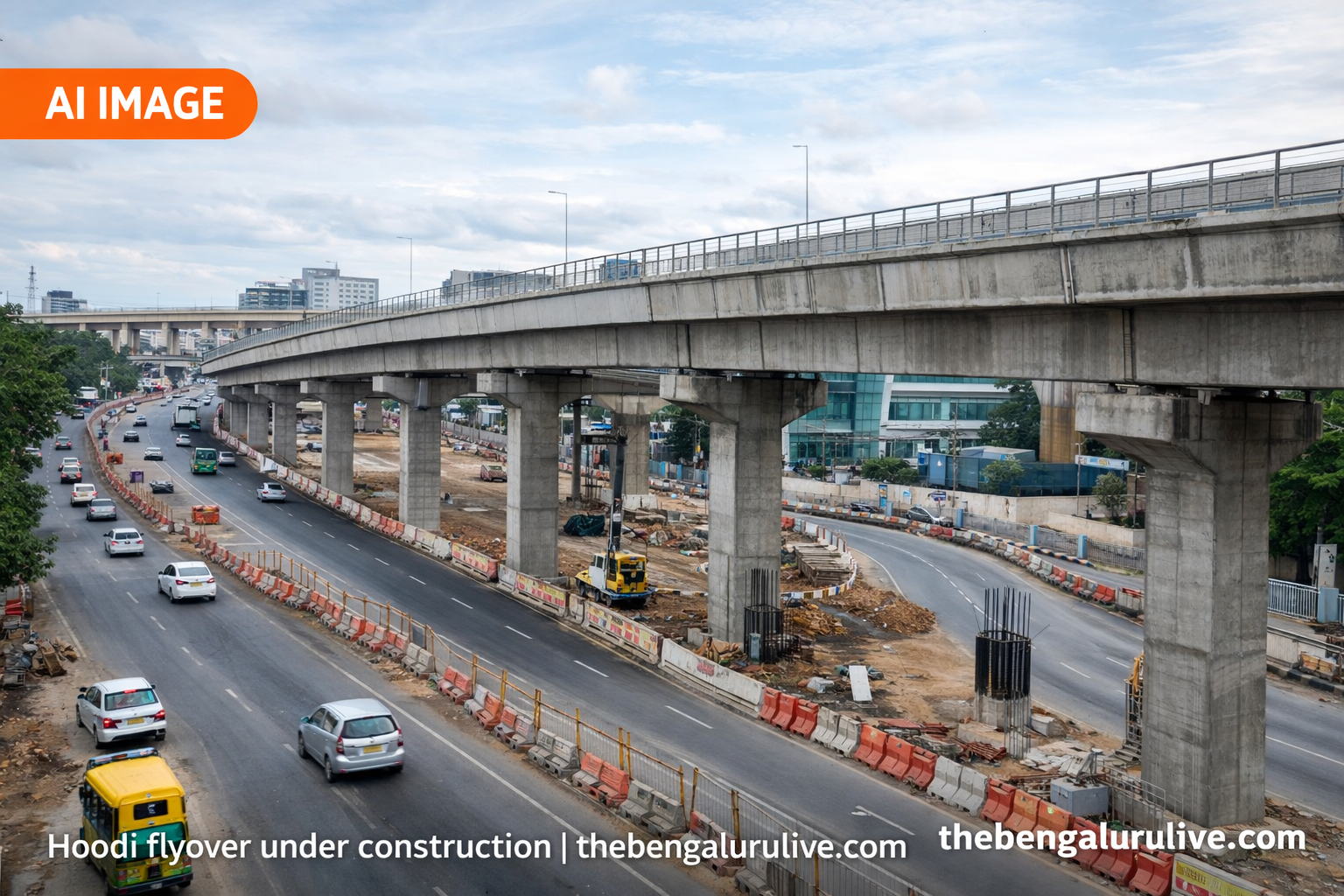
Bengaluru, February 4: Land acquisition has emerged as the single biggest obstacle delaying the Hoodi Flyover project, forcing the Bengaluru East City Corporation (BECC) to explore alternative funding and acquisition mechanisms such as Land Value Capture (LVC).
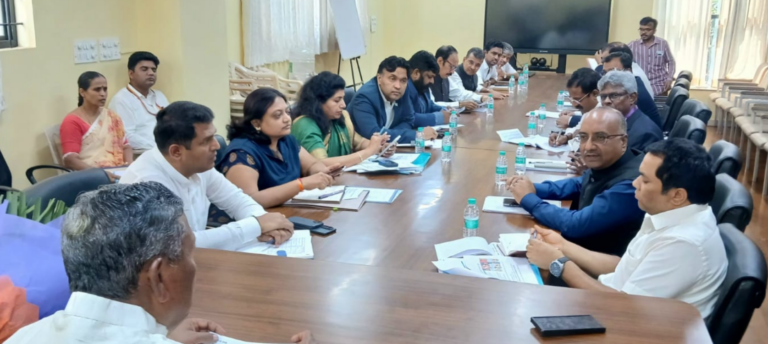
A high-level meeting chaired by Additional Commissioner (Development) Lokhande Snehal Sudhakar was held on Tuesday to examine the feasibility of adopting the LVC system for acquiring land required for the long-pending Hoodi Flyover.
Major Challenge: Land Acquisition Deadlock
Officials acknowledged that the refusal of landowners to accept Transferable Development Rights (TDR) has become the primary reason behind the project’s delay. Instead, landowners are insisting on cash compensation, which is not permissible under existing rules and regulations.
“This mismatch between landowner expectations and the legal framework has stalled the project,” the Additional Commissioner said, describing land acquisition as the critical bottleneck for the Hoodi Flyover.
Why Hoodi Flyover Matters
The Hoodi Flyover is considered crucial for easing chronic traffic congestion along one of Bengaluru East’s busiest corridors, connecting ITPL, Whitefield, Outer Ring Road, and Metro-linked zones. However, escalating land values and legal constraints have made traditional acquisition methods increasingly unviable.
Land Value Capture (LVC): The Proposed Solution
To break the deadlock, officials discussed implementing the Land Value Capture (LVC) mechanism, a model that allows governments to recover part of the land value appreciation generated by public infrastructure projects such as flyovers, Metro lines, and road widening.
Under LVC—particularly through land pooling—a portion of land is used for infrastructure development, while the remaining land benefits from a sharp increase in value post-development, offering long-term gains to landowners.
Why LVC Is Being Considered for Bengaluru East
Within the BECC limits, rapid urbanisation, Metro expansion, the Peripheral Ring Road (PRR), suburban rail projects, IT corridors, and Transit-Oriented Development (TOD) zones have led to a dramatic surge in land values.
Officials noted that conventional acquisition models are no longer practical in such high-growth zones, making LVC a strategic alternative that supports planned urban expansion without excessive fiscal burden on the civic body.
Key Challenges in Implementing LVC
While LVC offers a possible way forward, officials flagged several challenges that must be addressed before implementation:
- Accurate valuation of land in fast-developing areas
- Legal clarity and a uniform regulatory framework
- Public acceptance of non-cash compensation models
- Coordination among multiple civic and planning agencies
The Town Planning Department has been directed to submit a detailed feasibility report addressing these concerns.
Public Appeal for Cooperation
Citing successful implementation of LVC-based infrastructure projects in other states, the Additional Commissioner appealed to landowners and the public to cooperate.
“This could be the first LVC-based flyover project under the Bengaluru East City Corporation. With public cooperation, the Hoodi Flyover can be executed in a legal, transparent, and time-bound manner,” he said.
The meeting was attended by officials from the Town Planning Department, Land Survey and Records, Land Acquisition and TDR divisions, along with Assistant Executive Engineers and Assistant Engineers.
ಇದನ್ನೂ ಓದಿ: ಹೂಡಿ ಫ್ಲೈಓವರ್ ವಿಳಂಬಕ್ಕೆ ಭೂಸ್ವಾಧೀನವೇ ಕಾರಣ: ನಗದು ಬೇಡಿಕೆ–TDR ನಿರಾಕರಣೆ ನಡುವೆ LVC ಪರಿಗಣನೆ
About the Author