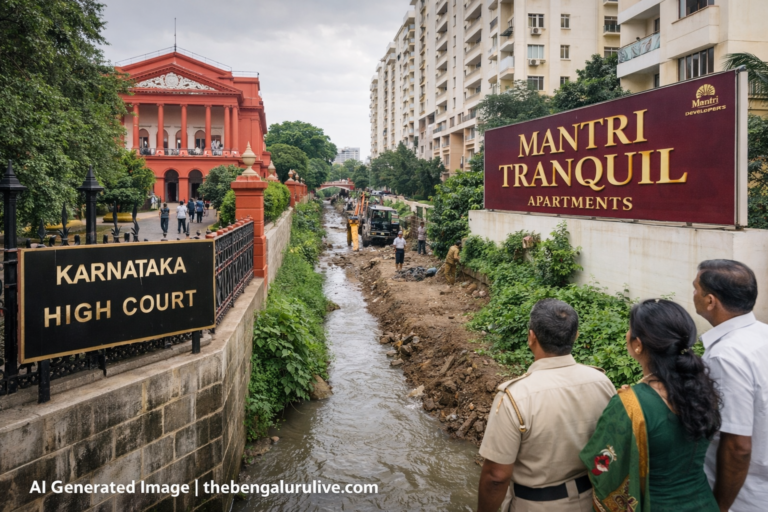
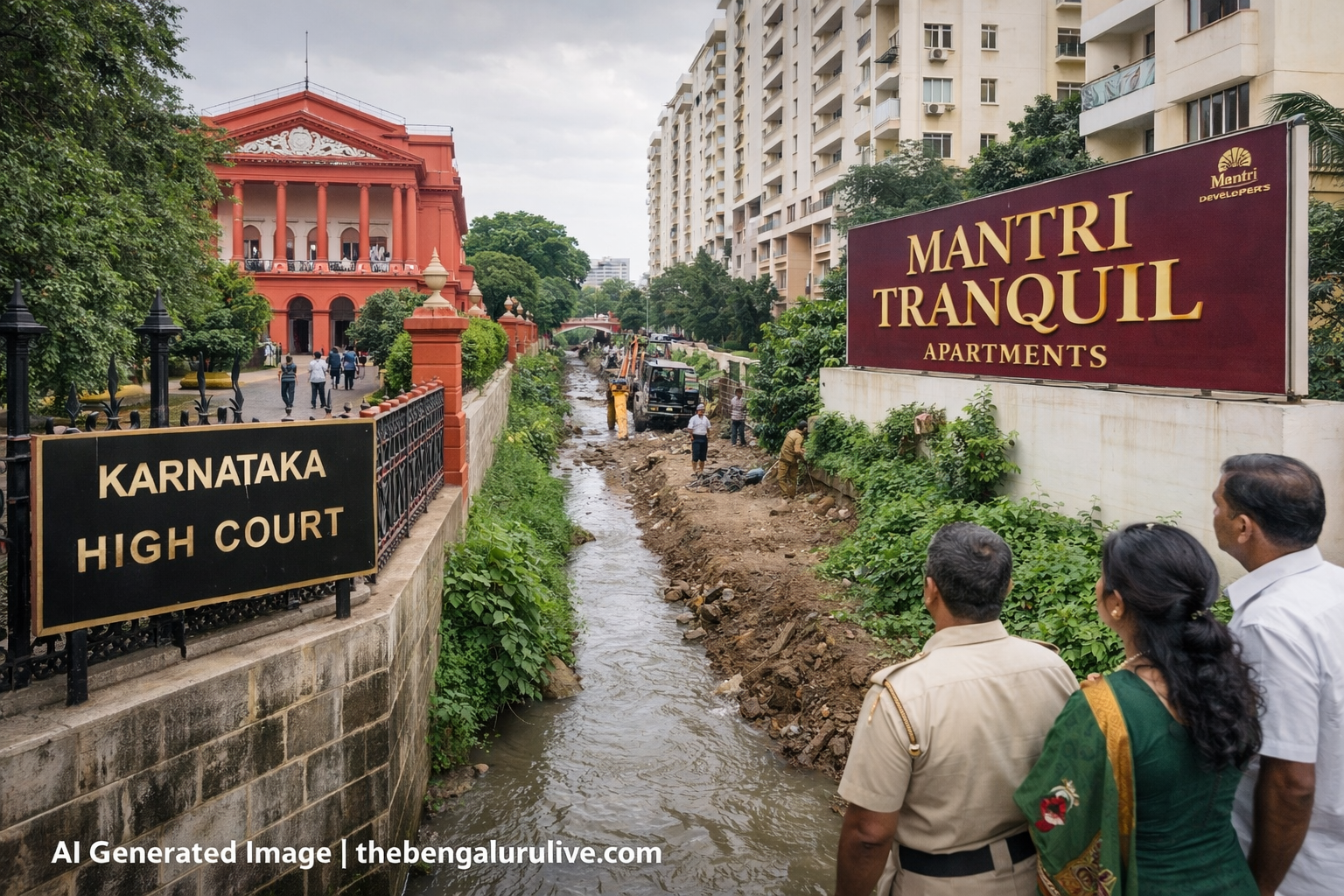
Bengaluru, Feb. 6: The Karnataka High Court on February 6, 2026, directed restoration of a storm water drain (Raja Kaluve) allegedly encroached upon by residential developments in Gubbalala Village, Uttarahalli Hobli, observing that public drainage infrastructure cannot be compromised in the guise of sanctioned construction.
Delivering the judgment in Writ Petition No.40299/2014 c/w W.P. No.47937/2019, Justice R. Nataraj examined the dispute between Mantri Tranquil Apartments Owners Association, Royal Palms Residents Welfare Association, developers, and the Bruhat Bengaluru Mahanagara Palike (BBMP).
Background of the Case
The petitions challenged notices issued by BBMP alleging that portions of the Mantri Tranquil apartment complex and adjoining layout had been constructed over a storm water drain running through Survey Nos. 7 and 11 of Gubbalala village, which ultimately feeds into Subramanyapura Lake.
The apartment associations contended that:
- The lands were converted for non-agricultural residential use in 2004–05.
- Building plans were sanctioned by the Bangalore Development Authority (BDA).
- Occupancy certificates were issued.
- No storm water drain was shown in the Comprehensive Development Plan (CDP) 1995 at the time of approval.
- The notices were issued nearly eight years after completion of construction.
BBMP, on the other hand, relied on:
- Village maps showing the existence of a Raja Kaluve passing through the survey numbers.
- A survey conducted following directions issued in an earlier Public Interest Litigation (W.P. No.31394/2009) concerning removal of encroachments over storm water drains in Bengaluru.
- Survey findings that an extent measuring approximately 242.8 metres in length and 5 metres in width (around 12 guntas) had been encroached.
Court’s Findings
Justice Nataraj noted that:
- The village map clearly indicated a storm water drain passing through Survey Nos. 7 and 11 and draining into Subramanyapura Lake.
- Conversion orders reflected deduction of ‘B’ kharab land for storm water drains.
- Subsequent surveys and expert committee inspections identified four major drains in the catchment area.
- Hydrological studies revealed that the existing drain cross-sections were inadequate for the catchment discharge.
- Drain Nos. 3 and 4 feeding into Subramanyapura Lake were found obstructed.
The Court observed that storm water drains play a crucial role in flood mitigation, groundwater recharge, and maintaining lake ecosystems, particularly in a rapidly urbanising city like Bengaluru.
It also noted that interim orders granted earlier had kept the dispute pending for over a decade.
Directions Issued
The High Court:
- Refused to interfere with BBMP’s action to remove encroachments over the storm water drain.
- Recognised the obligation of civic authorities to restore the drainage network in compliance with earlier PIL directions.
- Took note of expert committee recommendations that the drain sections must be widened to accommodate catchment discharge.
- Observed that public infrastructure cannot be nullified merely because building plans were sanctioned.
- Allowed authorities to proceed in accordance with law for restoration of the storm water drain.
The Court also recorded that the petitioners had submitted a representation dated December 12, 2025, seeking a practical solution balancing public infrastructure and residents’ interests, but made it clear that restoration of the storm water drain remained paramount.
Broader Impact
The judgment reinforces earlier High Court directions mandating removal of encroachments over Bengaluru’s storm water drains and comes amid heightened concern over urban flooding in the city.
With Subramanyapura Lake forming a key drainage endpoint, the Court emphasised that drainage corridors cannot be obstructed under any circumstances.
The ruling is expected to have implications for other developments situated along identified Raja Kaluves in Bengaluru.
Further compliance action by BBMP is awaited.
ಇದನ್ನೂ ಓದಿ: ಮಂತ್ರಿ ಟ್ರ್ಯಾಂಕ್ವಿಲ್ ಪ್ರಕರಣದಲ್ಲಿ ಸ್ಟಾರ್ಮ್ ವಾಟರ್ ಡ್ರೇನ್ ಮರುಸ್ಥಾಪನೆಗೆ ಹೈಕೋರ್ಟ್ ಆದೇಶ
About the Author