
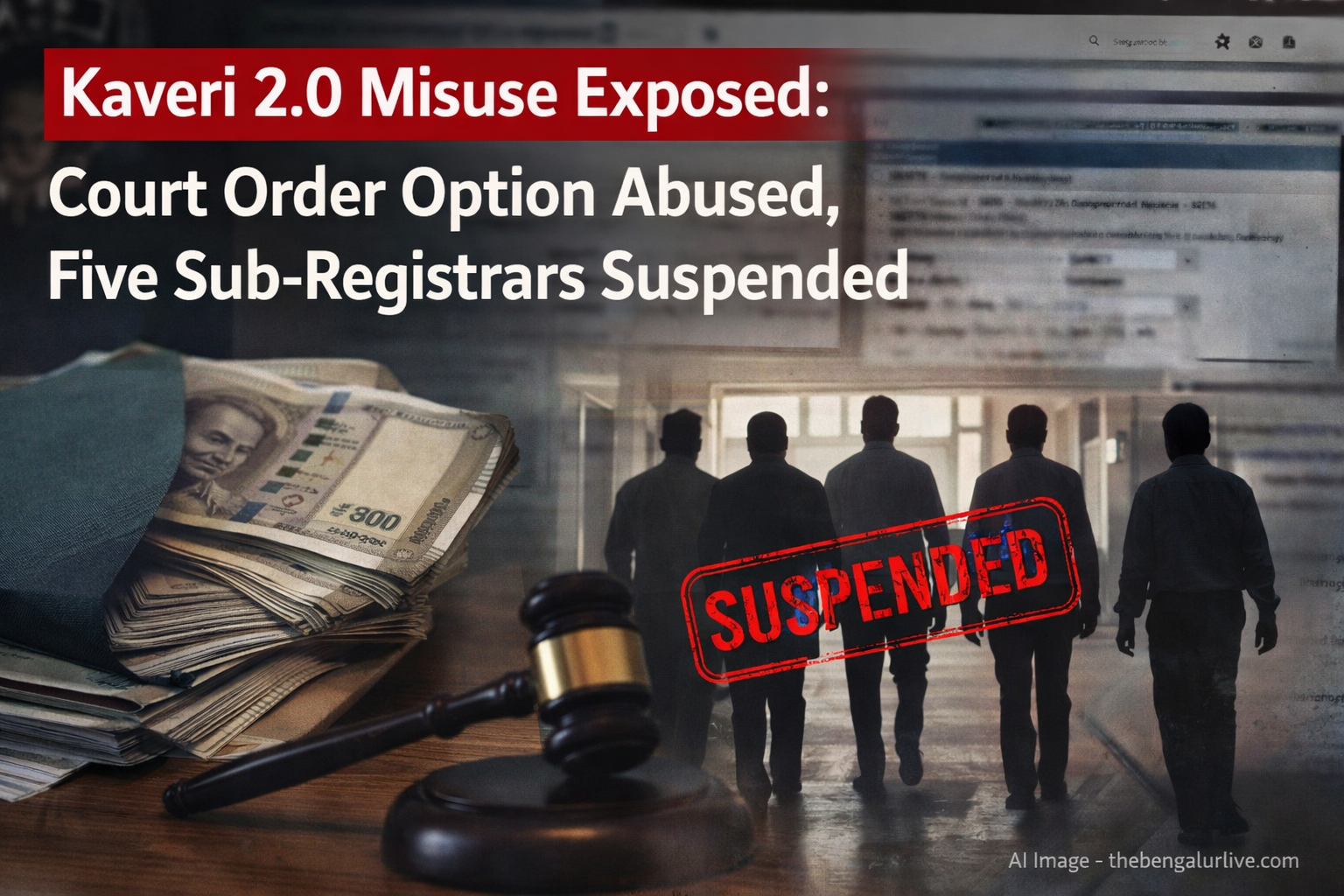
Bengaluru: The Department of Stamps and Registration, Government of Karnataka, has uncovered serious irregularities in the use of the Kaveri 2.0 property registration software, leading to the suspension of five Sub-Registrars and the launch of a comprehensive departmental inquiry.
According to an official press note, the Kaveri 2.0 system provides a special workflow for registrations carried out based on court orders, allowing certain exemptions within the software. However, investigations revealed that this option was fraudulently misused to register documents even in cases where no court orders existed.
At the Sarjapur Sub-Registrar Office, the court-order option was wrongly invoked, resulting in the registration of multiple sale deeds without any judicial direction. Following the detection of these irregularities, Sub-Registrar Ravi Sankana Gouda has been placed under immediate suspension, pending a detailed inquiry into all affected cases.
e-Swathu Norms Violated at Multiple Offices
Further scrutiny revealed violations at the Banaswadi, Varthur and Halasuru Sub-Registrar Offices, where sale deeds were registered without mandatory import of e-Khata data from the e-Swathu software, despite the information being unavailable in the system. This constituted a direct violation of prescribed registration procedures.
Out of the five Sub-Registrars involved in these illegal registrations, one has since retired. The remaining four officials have been placed under suspension with effect from January 2, 2026, pending completion of departmental proceedings.
The suspended officials are:
- N. Satish Kumar
- Sridhar (First Division Assistant – In-charge Sub-Registrar)
- Girish Chandra
- R. Prabhavathi
Strict Action Promised
The Department of Stamps and Registration has stated that strict disciplinary action will be taken against officials found guilty, in accordance with applicable service rules, once the departmental inquiry is completed.
The government said the action reflects its zero-tolerance approach towards misuse of digital governance platforms such as Kaveri 2.0 and e-Swathu, and reiterated its commitment to ensuring transparency, legality and accountability in property registrations.
ಇದನ್ನೂ ಓದಿ: ಕಾವೇರಿ 2.0 ದುರ್ಬಳಕೆ ಬಯಲು: ಕೋರ್ಟ್ ಆದೇಶ ಇಲ್ಲದೆ ದಾಖಲೆ ನೋಂದಣಿ, 5 ಉಪನೋಂದಣಾಧಿಕಾರಿಗಳ ಅಮಾನತು
About the Author