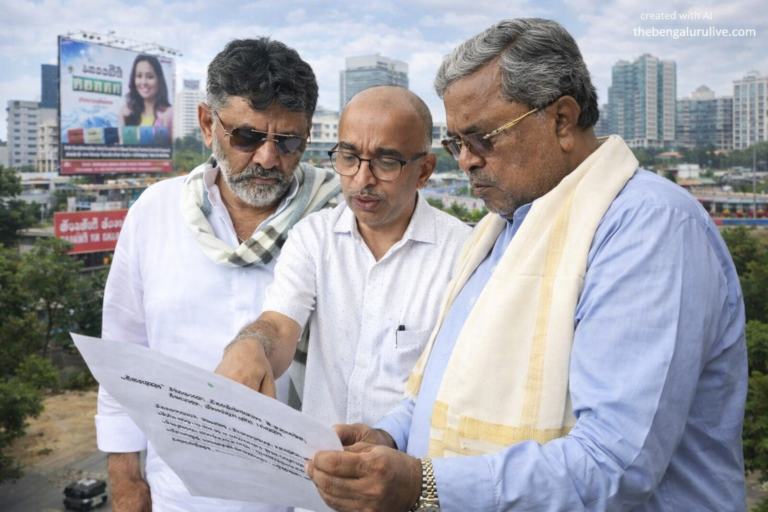

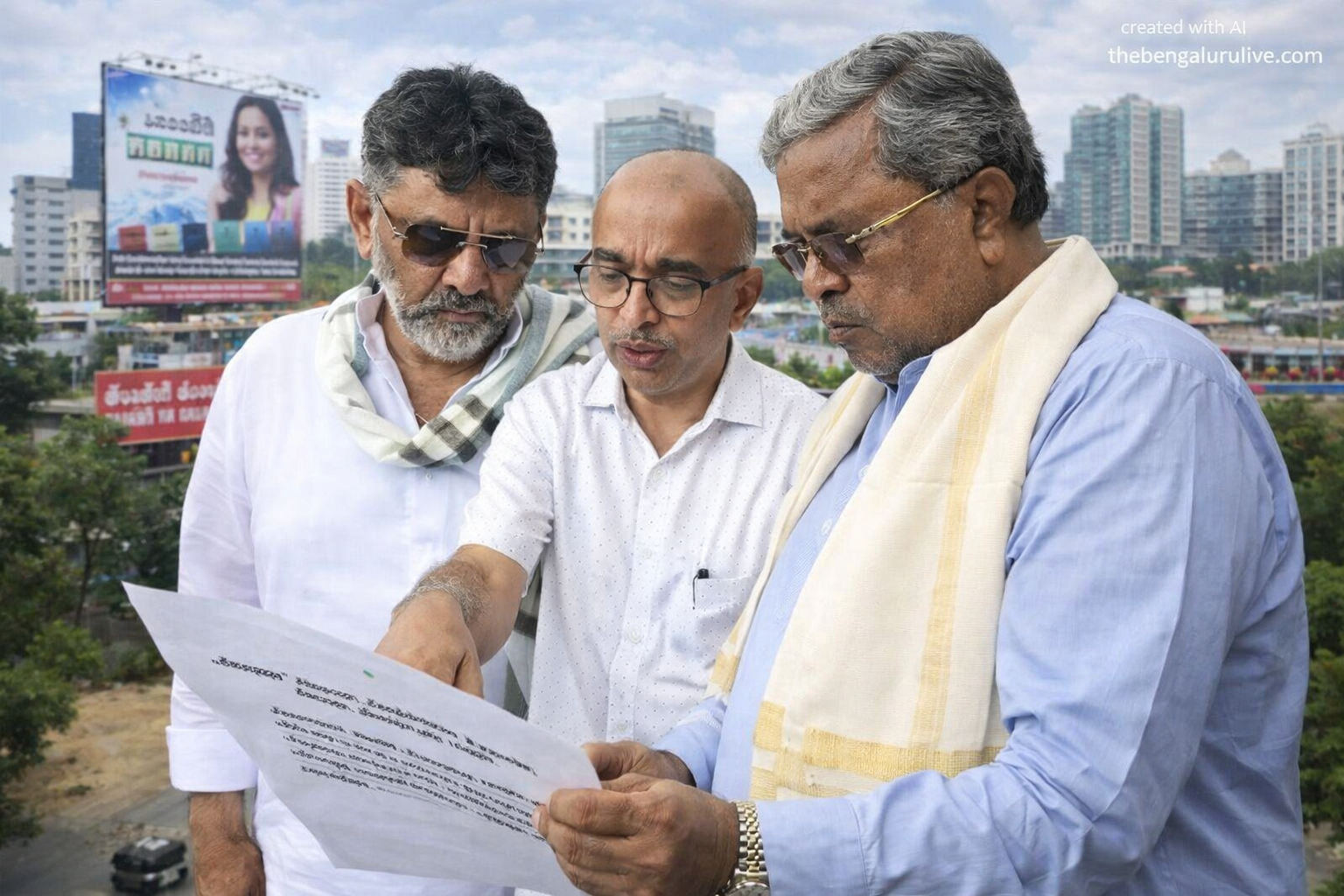
Chief Minister Siddaramaiah serves as the Chairman, while Deputy Chief Minister D.K. Shivakumar holds the position of Vice-Chairman of the GBA. BSWML CEO Karegowda has been appointed as the Nodal Officer to centrally oversee and supervise the OTO process.
Bengaluru: A rapid chain of administrative decisions following the notification of the Greater Bengaluru Area (Advertisement) Rules, 2025 has triggered widespread debate across Karnataka’s political and bureaucratic corridors.
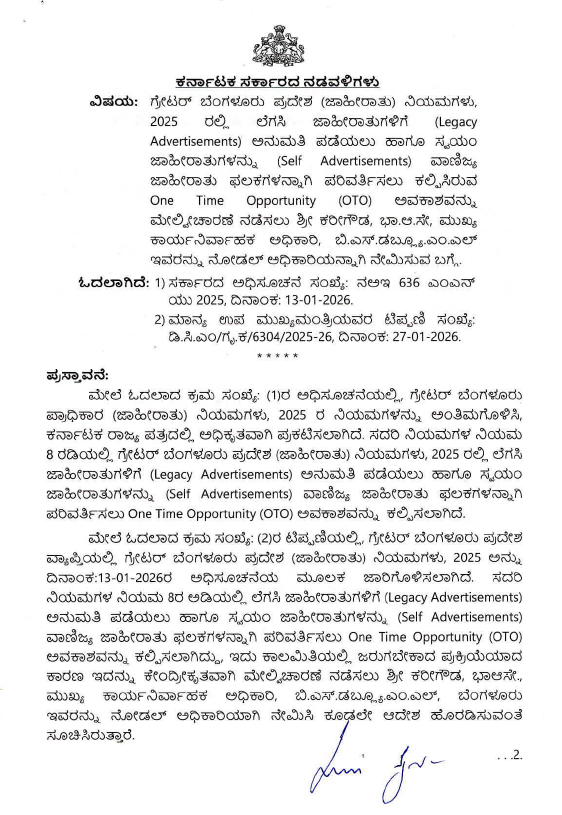
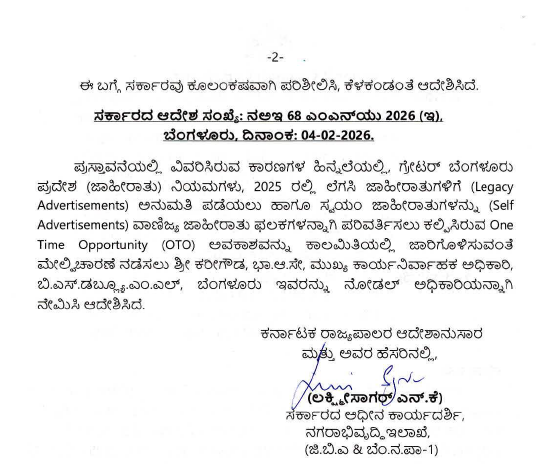
The new Advertisement Rules were officially notified on January 13, 2026. Within days, Deputy Chief Minister DK Shivakumar, who also holds the Urban Development portfolio, recorded a reference note on January 27, 2026, specifically addressing implementation of Rule 8 — the provision granting a One Time Opportunity (OTO) for legacy hoardings.
Soon after, on February 4, 2026, the Urban Development Department issued a formal order appointing Shri Karegowda, IAS, Chief Executive Officer of BWSML, as the Nodal Officer to centrally monitor and supervise the OTO process.
The speed of these developments has raised eyebrows in both Vidhana Soudha and Vikas Soudha.
What is a “Legacy Advertisement”?
Under the Greater Bengaluru Area (Advertisement) Rules, 2025, a Legacy Advertisement refers to:
Commercial advertisements, including billboards, erected on private or public property by approved, enrolled, or registered agencies after obtaining permission under the BBMP Advertisement Bye Laws, 2006, and which:
- Have a subsisting agreement signed with BBMP; or
- Had valid BBMP display permission as on January 1, 2016; or
- Had applied for renewal in response to BBMP newspaper advertisements dated 06.08.2015 or 09.10.2015, with proper acknowledgment.
Additionally, a hoarding qualifies as “legacy” if:
- It was permitted in writing under BBMP Advertisement Bye Laws, 2006,
- Advertisement tax was paid at least until 31.12.2015 (when renewals were halted) or until continued display — whichever is later,
- And it either had valid permission beyond 31.12.2015 or had applied for renewal in response to BBMP notices with acknowledgment.
What Does the One Time Opportunity (OTO) Provide?
The Rules grant a three-month window from the date of final notification to apply for regularisation.
Key conditions include:
- No pending advertisement tax or fee arrears,
- Mandatory No-Dues Certificate from the Advertisement Section,
- Scrutiny and approval by the Commissioner of the concerned City Corporation,
- Permission to display commercial advertisements for five years from approval date,
- Mandatory discontinuation after five years,
- Compliance with prescribed size, height, ground clearance, and other technical norms.
This OTO provision potentially affects nearly 1,000 legacy hoardings currently operating across Bengaluru.
Why Karegowda’s Appointment Is Being Watched Closely
Traditionally, advertisement matters fall under the designated advertisement regulatory authority within BBMP or Greater Bengaluru framework. However, in a significant administrative shift, oversight has been assigned to the CEO of BWSML.
Sources confirm that this centralised monitoring mechanism was introduced considering the time-bound nature of OTO implementation.
Yet, the move has sparked discussion:
- Why was the task not retained within the existing advertisement regulatory chain?
- Is this a compliance clean-up exercise or a broader restructuring of Bengaluru’s outdoor advertising ecosystem?
- Does it signal tighter financial scrutiny?
Talks With Hoarding Owners Underway
Sources indicate that at least one round of discussions has already taken place with legacy hoarding owners. Further meetings are expected as stakeholders attempt to arrive at a mutually workable implementation framework within the three-month OTO window.
Industry insiders suggest the government may be seeking:
- Revenue rationalisation
- Legal closure of long-pending disputes
- Standardised compliance norms
The Larger Picture
The sequence is striking:
- Jan 13 – Rules notified
- Jan 27 – DCM’s reference note
- Feb 4 – Nodal officer appointed
The administrative urgency suggests the government intends to fast-track regularisation.
With a 3-month OTO clock already ticking and nearly a thousand hoardings under scrutiny, Bengaluru’s skyline — and its advertisement economy — may soon undergo a structured transformation.
Whether this is merely regulatory reform or the beginning of a deeper reshaping of the outdoor advertising sector remains a question many are closely watching.
ಇದನ್ನೂ ಓದಿ: DCM ವೇಗದ ನಿರ್ಧಾರ, 3 ತಿಂಗಳ OTO ವಿಂಡೋ, 1,000 ಲೆಗಸಿ ಹೋರ್ಡಿಂಗ್ಗಳಿಗೆ ಹಸಿರು ನಿಶಾನೆ? ಬೆಂಗಳೂರಿನ ಜಾಹೀರಾತು ರೀಸೆಟ್ ಆರಂಭ
About the Author